
"We need more content!" — every marketer's cry
Sound familiar? Management wants 3 posts a day, 5 Reels a week, a weekly newsletter, and a daily Telegram channel. And the team is one content manager and a part-time designer.
You can hire more people. But scaling with people has a ceiling: every new hire means training, quality control, sick days, resignations. And worst of all — the content still comes out uneven.
What if content production could be automated the way Tesla automates assembling cars?
The solution: a fully automated content "factory"
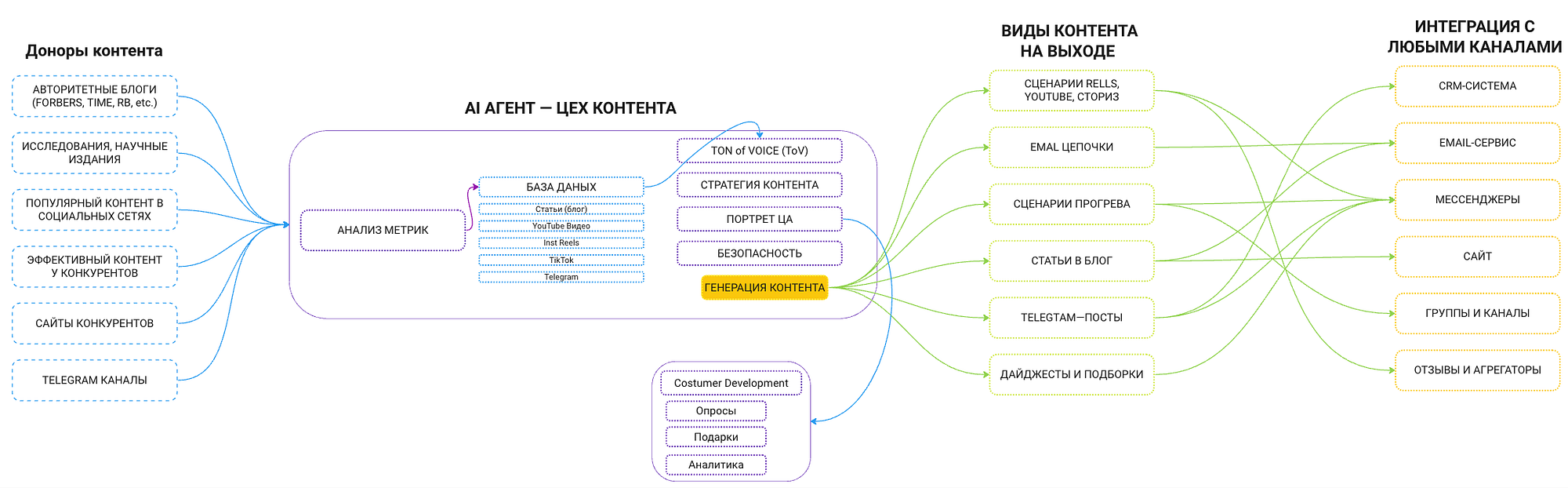
We built an AI system that runs like a conveyor:
Stage 1: Data collection
The AI gathers information from authoritative sources, social networks, research, Telegram channels, and competitor content. Not blindly — but by defined topics, keywords, and trends.
Stage 2: Analysis and strategy
The system analyzes the metrics: which topics gain reach, which formats work, and when to publish. The AI doesn't "make things up" — it makes decisions on data.
Stage 3: AI content generation
Based on the strategy, the audience profile, and the brand tone, the AI creates:
- Reels scripts — with hooks, reveals, and CTAs
- Email campaigns — personalized, segmented
- Blogs and articles — SEO-optimized, with expert depth
- Telegram posts — in the right tone and format
Stage 4: Video production
Using digital avatars, the AI voices, animates, and edits the clips. One person manages a process that used to require 5.
Stage 5: Integration and publishing
The finished content is automatically integrated with the CRM, messengers, email services, and the website. Publishing runs on schedule, with no manual work.
1,000+ Reels — and that's not a typo
| Parameter | Value |
| --- | --- |
| Reels produced | 1,000+ |
| Team increase | 0 people |
| Time per clip (before) | 2–4 hours |
| Time per clip (AI) | 15–30 minutes |
| Content types | Reels, Email, Blog, Telegram |
Imagine: you launch 1,000 clips over a few months. Each one with a thought-out script, the right hook, and a call to action. And not one of them required hiring a new employee.

What sets AI content apart from "robotic" junk?
It's important to understand: we're not talking about random text from ChatGPT. The system uses:
Data, not guesses: every script is based on an analysis of what already works in the niche.
Brand tone: the AI is trained on a specific brand's style — it doesn't generate "average" content.
Audience profile: what hurts, what interests them, how they talk — all of it is taken into account.
Digital avatars: the videos look real — because the AI avatar is built on a real person.
The economics: numbers that interest a CEO
Cost of 1 clip via a freelancer: $150–300 (script + filming + editing)
Cost of 1,000 clips: $150,000–300,000
Cost with the AI factory: many times less — at comparable (and often superior) quality.
But it's not only about money. It's about speed. While competitors plan a content calendar for the month — you've already published it.
Who this is for
- Businesses that need content at volume — but lack the resources for a big team
- Agencies that want to scale production without a proportional rise in costs
- Personal brands that need steady publishing without burnout
- International companies that need content in several languages
Content is fuel for marketing. The AI factory is the refinery that produces that fuel at industrial scale.
This case is based on a real AI content factory launched by StaffAI. All screenshots are from the live system.